
Samsung Electronics Co., Ltd. (KRX: 005930) is one of the world’s largest technology conglomerates and South Korea’s most prominent corporate entity. Listed on the Korea Exchange, Samsung Electronics commands a market capitalization of approximately 1,261 trillion KRW and operates across a vast spectrum of technology segments — from memory semiconductors and display panels to smartphones and home appliances. This 005930 company analysis provides a detailed look at the company’s business model, revenue composition, competitive positioning, and considerations for those evaluating the stock.
1. Company Introduction & Business Structure
Corporate Profile
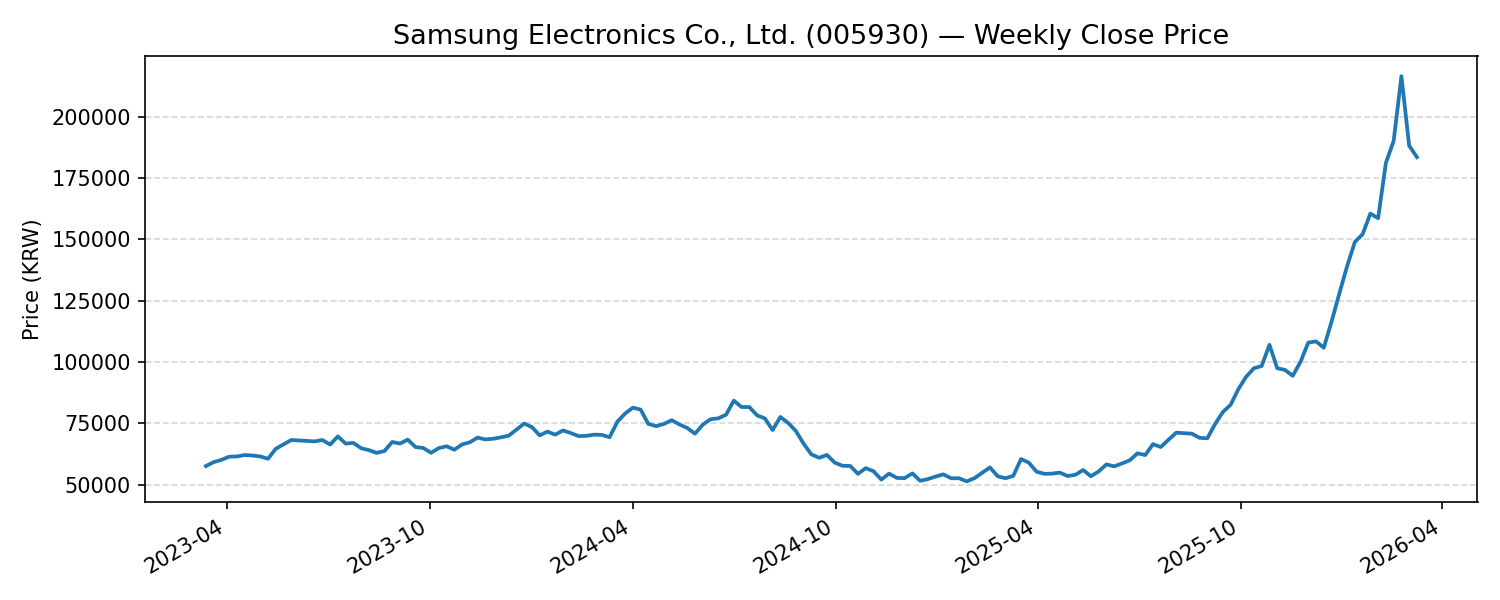
Samsung Electronics was established in 1969 as a subsidiary of the Samsung Group. Headquartered in Suwon, Gyeonggi Province, South Korea, the company has grown from a domestic electronics manufacturer into a global technology leader with operations spanning more than 70 countries. As of the most recent data, Samsung Electronics trades at approximately 188,700 KRW per share.
Organizational Structure
Samsung Electronics organizes its operations into three primary business divisions:
- Device Solutions (DS) Division — Encompasses the semiconductor (Memory and System LSI) and display panel businesses. This division is widely regarded as the company’s core profit engine and the primary driver of cyclical earnings volatility.
- Device eXperience (DX) Division — Covers consumer-facing products including mobile communications (smartphones, tablets, wearables) and visual display products (TVs, monitors).
- Harman International — A wholly owned subsidiary acquired in 2017, specializing in connected car technologies, audio systems, and enterprise solutions.
This three-pillar structure allows Samsung to participate across the entire electronics value chain — from upstream component manufacturing to downstream consumer products — creating a vertically integrated business model that few competitors can replicate.
2. Key Products & Services
Semiconductors
Samsung is the world’s largest memory chip manufacturer, holding leading market share in both DRAM and NAND flash memory. The company also operates a growing foundry (contract chipmaking) business and designs System-on-Chip (SoC) processors under the Exynos brand.
Key semiconductor product lines include:
- DRAM — Used in servers, PCs, and mobile devices
- NAND Flash — Used in solid-state drives (SSDs), smartphones, and data centers
- Foundry Services — Contract manufacturing of logic chips for external clients
- System LSI — Application processors, image sensors, and modem chips
Mobile & Consumer Electronics
Samsung is the world’s largest smartphone manufacturer by unit shipments. The Galaxy S series (flagship), Galaxy A series (mid-range), and Galaxy Z series (foldable) constitute the major product families. Beyond smartphones, the company produces tablets (Galaxy Tab), wearables (Galaxy Watch, Galaxy Buds), and laptops (Galaxy Book).
Display Panels
Samsung Display, a subsidiary, is a leading manufacturer of OLED panels for smartphones, tablets, and increasingly for laptops and automotive applications. The company has been at the forefront of flexible and foldable display technology.
Home Appliances & Visual Display
Samsung manufactures a broad range of consumer appliances — refrigerators, washing machines, air conditioners, and vacuum cleaners — as well as televisions and monitors. The company’s QLED and Neo QLED TV lineups compete at the premium end of the market.
Harman & Automotive
Through Harman International, Samsung has a growing presence in connected car solutions, premium audio systems (JBL, Harman Kardon, AKG, Bang & Olufsen branded products), and enterprise communication platforms.
3. Revenue Composition Analysis
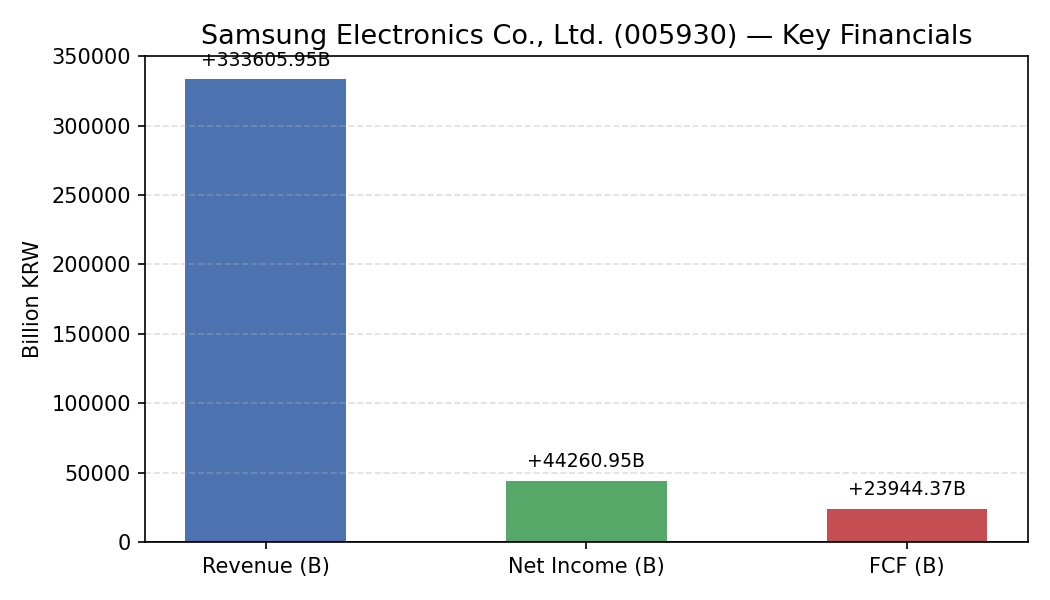
Samsung Electronics reported total revenue of approximately 333.6 trillion KRW, reflecting year-over-year revenue growth of 23.8%. This growth was driven primarily by a recovery in the semiconductor business cycle and sustained demand in the mobile segment.
Revenue by Division
While exact segment breakdowns shift quarter to quarter, the general revenue composition follows a well-established pattern:
- Device Solutions (Semiconductors + Display): Historically accounts for roughly 35–45% of total revenue, but a disproportionately large share of operating profit during upcycles in the memory market.
- Mobile Communications: Typically contributes around 35–40% of total revenue, providing relatively stable cash flows compared to the cyclical semiconductor segment.
- Consumer Electronics (Visual Display, Home Appliances): Generally represents 15–20% of revenue, serving as a steady but lower-margin business line.
- Harman and Others: Contributes a smaller but growing share of overall revenue.
Profitability Metrics
The company reported net income of approximately 44.3 trillion KRW and an operating margin of 21.3%. The operating margin figure is noteworthy and indicates a period of healthy profitability, particularly in the semiconductor division where margins can swing dramatically depending on supply-demand dynamics in the memory market.
Samsung’s free cash flow stood at approximately 23.9 trillion KRW, underscoring the company’s strong cash generation capability even while maintaining significant capital expenditure programs — particularly in semiconductor fabrication facility (fab) expansion.
The company maintains a conservative balance sheet, with a debt-to-equity ratio of just 5.8%, providing substantial financial flexibility for investment and shareholder returns.
4. Competitive Advantages & Core Competencies
Vertical Integration
Samsung’s most distinctive competitive advantage is its unparalleled vertical integration. The company manufactures its own memory chips, display panels, application processors, and camera sensors — many of which are used in its own end products. This integration provides cost advantages, supply chain resilience, and the ability to bring innovations to market faster than competitors who rely on third-party suppliers.
Scale & Manufacturing Expertise
Samsung operates some of the world’s largest and most advanced semiconductor fabrication facilities. The sheer scale of its manufacturing operations in DRAM, NAND, and OLED panels creates significant economies of scale and barriers to entry. The capital intensity of these industries — new fabs can cost upward of $20 billion — inherently limits competition.
Technology Leadership in Memory
In the DRAM market, Samsung competes primarily with SK Hynix and Micron Technology. In NAND flash, the competitive set includes SK Hynix (Solidigm), Kioxia, Western Digital, and Micron. Samsung has historically maintained a technology lead, being among the first to introduce new process nodes and stacking technologies (such as V-NAND).
Brand Power in Consumer Electronics
Samsung is consistently ranked among the world’s most valuable brands. In the smartphone market, the Galaxy brand competes directly with Apple’s iPhone at the premium tier while also capturing volume share in the mid-range and budget segments — a dual strategy that Apple does not pursue.
R&D Investment
Samsung Electronics is one of the largest R&D spenders globally, investing heavily across semiconductors, displays, mobile technologies, AI, and next-generation computing. This sustained investment supports its ability to lead or fast-follow in critical technology transitions.
HBM and AI-Related Semiconductor Demand
The rapid expansion of artificial intelligence workloads has driven significant demand for High Bandwidth Memory (HBM), a specialized DRAM product used in AI accelerators and GPUs. Samsung, alongside SK Hynix, is a key supplier in this high-growth segment, which has become a critical battleground for memory makers.
5. Recent Key Developments
AI and HBM Momentum
The global AI infrastructure buildout has placed Samsung’s semiconductor division squarely in focus. The company has been expanding its HBM production capacity and working to qualify its latest-generation HBM products with major AI chip customers. Competition with SK Hynix in the HBM space has been intense, with both companies racing to deliver higher-capacity, more power-efficient memory solutions.
Foundry Business Challenges and Investments
Samsung’s contract chip manufacturing (foundry) business has faced competitive pressure from industry leader TSMC. The company has been investing heavily in advanced process nodes (3nm GAA technology and beyond) to close the gap, though yield rates and customer confidence remain areas of focus.
Smartphone Market Dynamics
In the global smartphone market, Samsung has continued to defend its unit-shipment leadership position. The Galaxy S series flagships incorporating on-device AI features and the expanding Galaxy Z foldable lineup represent key product strategies. Competition from Apple and Chinese manufacturers (Xiaomi, OPPO, vivo) remains intense.
Shareholder Return Policies
Samsung Electronics has maintained a shareholder return program that includes regular dividends and share buybacks. The company’s capital allocation decisions are closely watched by investors seeking a balance between growth investment (fab expansion) and returns to shareholders.
Geopolitical and Supply Chain Considerations
As a globally integrated technology manufacturer, Samsung is navigating an increasingly complex geopolitical landscape. U.S.–China trade tensions, semiconductor export controls, and government incentive programs (such as the U.S. CHIPS Act) all influence Samsung’s strategic planning, particularly regarding fab locations and customer relationships.
6. Key Investment Considerations
Cyclicality of the Semiconductor Business
The memory semiconductor industry is inherently cyclical. Samsung’s earnings can swing significantly depending on DRAM and NAND pricing, which are driven by supply-demand balances that shift with data center investment cycles, consumer electronics demand, and competitor capacity additions. Investors should be prepared for meaningful quarter-to-quarter earnings volatility.
Capital Expenditure Requirements
Maintaining technological leadership in semiconductors and displays requires sustained, large-scale capital expenditure. Samsung routinely invests tens of trillions of KRW annually in new fabs and equipment upgrades. While these investments are necessary for long-term competitiveness, they can pressure free cash flow in heavy investment years.
Competition in Foundry
Samsung’s ambition to become a stronger competitor to TSMC in the foundry business is a multi-year endeavor with uncertain outcomes. Securing and retaining major foundry customers requires consistent execution on yield, technology roadmap, and delivery timelines.
Currency and Macroeconomic Exposure
As a major exporter, Samsung’s financial results are sensitive to exchange rate fluctuations, particularly the KRW/USD rate. Global macroeconomic conditions also influence demand across the company’s product lines.
Governance and Conglomerate Structure
Samsung Electronics is part of the broader Samsung Group, and governance dynamics — including the role of the founding Lee family, cross-shareholding structures, and regulatory scrutiny in South Korea — are factors that some investors weigh when evaluating the stock.
AI Tailwinds vs. Execution Risk
The AI-driven demand for HBM and advanced memory products represents a significant growth opportunity. However, Samsung faces execution risk in HBM qualification timelines and competitive positioning relative to SK Hynix, which has established an early lead with some key customers.
Valuation Context
At a share price of 188,700 KRW and a market capitalization of approximately 1,261 trillion KRW, Samsung Electronics is among the most valuable companies in Asia. Investors typically evaluate Samsung on a cyclically adjusted basis given the volatility of semiconductor earnings. Revenue growth of 23.8% and an operating margin of 21.3% reflect a period of strong operational performance, though sustainability depends on the memory cycle trajectory.
7. Frequently Asked Questions
What does Samsung Electronics (005930) primarily do?
Samsung Electronics is a diversified technology company that operates across semiconductors (DRAM, NAND, foundry), mobile devices (smartphones, tablets, wearables), display panels (OLED), consumer electronics (TVs, appliances), and connected car solutions (via Harman International).
Why is the semiconductor division so important to Samsung’s stock?
The semiconductor division — particularly memory chips — is Samsung’s largest profit contributor and the primary source of earnings cyclicality. Memory chip prices fluctuate based on supply and demand, causing significant swings in the company’s quarterly results. As a result, the semiconductor cycle is often the dominant factor in Samsung’s stock performance.
How does Samsung compare to competitors in the memory market?
Samsung is the world’s largest DRAM and NAND flash manufacturer by market share. Its primary competitors are SK Hynix and Micron Technology in DRAM, and SK Hynix (Solidigm), Kioxia, Western Digital, and Micron in NAND. Samsung has generally maintained a technology and scale advantage, though competition in specific segments like HBM has intensified.
What role does AI play in Samsung’s business outlook?
AI is a significant demand driver for Samsung’s memory business, particularly High Bandwidth Memory (HBM) used in AI training and inference hardware. Samsung is investing heavily to expand HBM capacity and qualify advanced HBM products with key customers. On-device AI features are also becoming increasingly important in Samsung’s smartphone product strategy.
Is Samsung Electronics the same as the Samsung Group?
No. Samsung Electronics is a publicly listed subsidiary of the broader Samsung Group conglomerate, which also includes Samsung SDI, Samsung SDS, Samsung Life Insurance, Samsung C&T, and other affiliates. Samsung Electronics is the largest and most prominent entity within the group.
Related Articles
- Understanding the Global Semiconductor Cycle and Its Impact on Korean Tech Stocks
- SK Hynix (000660) Company Analysis: HBM and the AI Memory Race
- KOSPI Index Overview: Key Sectors and Major Constituents
- Comparing Samsung and TSMC: Two Models for Semiconductor Manufacturing
Conclusion
Samsung Electronics (005930) is a global technology powerhouse with a uniquely diversified and vertically integrated business model. Its leadership position in memory semiconductors, dominant smartphone brand, and expanding presence in high-growth areas such as AI-related memory and advanced displays make it a central holding in the Korean equity market and a widely followed stock among international investors.
The company’s recent financial performance — highlighted by revenue of 333.6 trillion KRW with 23.8% growth, a 21.3% operating margin, and robust free cash flow generation — reflects a favorable position in the semiconductor cycle. At the same time, the inherent cyclicality of the memory business, heavy capital expenditure requirements, and competitive dynamics in foundry and HBM represent ongoing considerations.
For anyone conducting a 005930 company analysis, understanding the interplay between Samsung’s semiconductor cycle exposure, its consumer electronics stability, and its strategic positioning in the AI era is essential to forming a comprehensive view of the business.
Disclaimer: This article is not investment advice and is intended solely as a reference based on publicly available data at the time of writing. All investment decisions are made at your own discretion and risk. The financial figures cited in this article are based on data available as of the publication date and may not reflect the most current information. Readers should consult official filings and qualified financial advisors before making any investment decisions.