
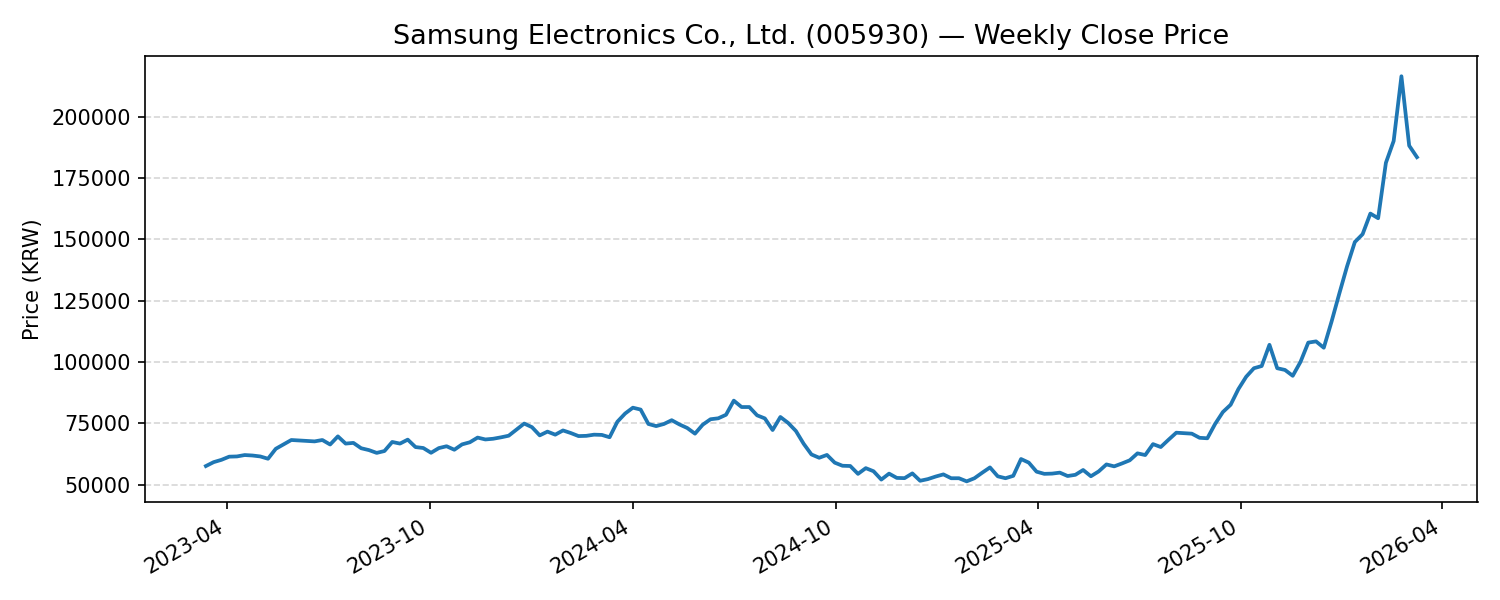
Samsung Electronics Co., Ltd. (KRX: 005930) remains one of the most closely watched companies in global equity markets. As the flagship entity of the Samsung Group and a cornerstone of South Korea’s technology sector, Samsung Electronics commands a market capitalization of approximately 1,261.7 trillion KRW (roughly USD 920 billion at recent exchange rates), making it the single largest constituent of the Korean stock market by weight.
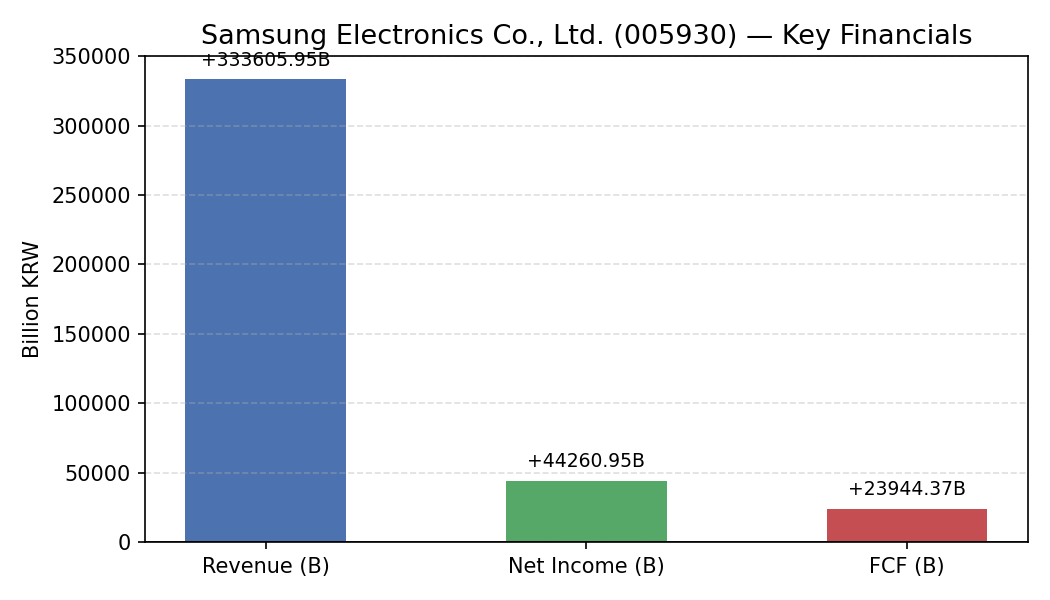
For investors and analysts tracking the 005930 revenue growth trajectory, the latest available financial data paints a picture of a company navigating a pronounced recovery cycle. With reported revenue of approximately 333.6 trillion KRW and year-over-year revenue growth of 23.8%, Samsung Electronics has posted one of its strongest top-line expansions in recent memory. Meanwhile, an operating margin of 21.3% suggests that the company is not merely chasing revenue at the expense of profitability — it is translating that growth into meaningful operating earnings.
This article examines the key financial trends behind Samsung Electronics’ recent growth, the business segments driving that performance, the outlook for sustained expansion, and the risk factors that investors should weigh carefully.
Revenue Growth Trends
A 23.8% Top-Line Expansion
Samsung Electronics reported total revenue of approximately 333.6 trillion KRW for the most recent fiscal period, representing a year-over-year increase of 23.8%. For a company of Samsung’s scale — one that already generates more revenue than many national GDPs — double-digit top-line growth of this magnitude is notable.
To contextualize this figure, it is worth recalling the semiconductor industry’s cyclical nature. The memory chip market, which constitutes a significant share of Samsung’s overall revenue, went through a severe downturn characterized by oversupply, falling average selling prices (ASPs), and inventory corrections across the global electronics supply chain. A 23.8% revenue recovery therefore reflects not only normalized demand conditions but also the structural uplift from emerging workloads such as high-bandwidth memory (HBM) for AI accelerators and next-generation server infrastructure.
Revenue Scale in Context
At 333.6 trillion KRW, Samsung Electronics’ annual revenue places it among the top ten technology companies globally by sales. The company’s diversified revenue base — spanning semiconductors, display panels, consumer electronics, and mobile devices — provides a degree of resilience that pure-play chipmakers or smartphone manufacturers typically lack.
The 005930 revenue growth rate of 23.8% also compares favorably with the broader Korean technology sector, which has experienced more modest aggregate growth rates over the same period. Samsung’s outsized contribution to Korea’s export figures, particularly in semiconductor shipments, underscores its systemic importance to both the domestic economy and global technology supply chains.
Revenue Composition and Quality
Revenue quality matters as much as revenue quantity. Several characteristics of Samsung’s recent top-line growth warrant attention:
- Mix shift toward higher-value products: The growing share of advanced memory products (such as DDR5 DRAM and V-NAND of 200+ layers) in the semiconductor division’s revenue mix has improved blended ASPs.
- Services and recurring revenue: While Samsung remains predominantly a hardware company, its growing ecosystem of software services, SmartThings platform integrations, and enterprise solutions contributes incremental recurring revenue.
- Geographic diversification: Samsung’s revenue base is globally distributed, with significant contributions from North America, Europe, and the Asia-Pacific region, reducing dependence on any single market.
Operating Profit Growth Analysis
Operating Margin of 21.3%
Samsung Electronics reported an operating margin of 21.3% for the most recent fiscal period. Applying this margin to the reported revenue of 333.6 trillion KRW yields an implied operating profit of approximately 71.1 trillion KRW.
This operating margin level represents a significant recovery from the trough margins observed during the semiconductor downcycle, when Samsung’s Device Solutions (DS) division — home to the memory and foundry businesses — posted operating losses for multiple consecutive quarters. The swing from operating losses to a consolidated margin above 21% illustrates the extreme operating leverage inherent in the semiconductor business: once fixed costs are covered, incremental revenue falls through to operating profit at high rates.
Profitability Drivers
Several factors have contributed to the operating margin recovery:
- Memory pricing recovery: DRAM and NAND flash prices have rebounded from cyclical lows as supply discipline improved and demand from data center and AI customers accelerated.
- Cost optimization initiatives: Samsung has pursued aggressive cost reduction programs, including fab consolidation, yield improvements on advanced process nodes, and supply chain efficiencies.
- Product mix enrichment: The shift toward premium products — flagship Galaxy smartphones, high-end OLED panels, and advanced memory chips — carries higher per-unit margins than commodity-tier offerings.
Net Income and Bottom-Line Conversion
Reported net income stands at approximately 44.3 trillion KRW. The gap between operating profit (~71.1 trillion KRW) and net income (~44.3 trillion KRW) reflects non-operating items including interest expenses, foreign exchange impacts, taxes, and equity-method investment gains or losses. A net-income-to-operating-profit conversion rate of roughly 62% is within the historical range for Samsung, given its significant capital expenditure requirements and the Korean corporate tax structure.
Free Cash Flow Generation
Samsung Electronics generated approximately 23.9 trillion KRW in free cash flow during the period. While free cash flow trails net income due to the company’s capital-intensive nature — Samsung routinely invests tens of trillions of KRW annually in semiconductor fabrication facilities — the fact that FCF remains solidly positive even during heavy investment cycles speaks to the underlying cash-generative power of the business.
The company maintains a conservative balance sheet with a debt-to-equity ratio of just 5.8%, one of the lowest among major global technology companies. This low leverage provides Samsung with significant financial flexibility to fund future capital expenditure, pursue strategic acquisitions, and return capital to shareholders without straining its balance sheet.
Growth Drivers by Business Segment
Samsung Electronics operates through three principal business divisions, each contributing distinct growth dynamics:
1. Device Solutions (DS) Division — Semiconductors
The DS division, encompassing both the Memory and System LSI/Foundry businesses, is the primary engine of Samsung’s earnings volatility and growth potential.
- Memory (DRAM & NAND): Memory chips account for the largest share of Samsung’s operating profit in upcycle periods. The current cycle is being amplified by extraordinary demand for HBM chips used in AI training and inference servers. Samsung is investing heavily to scale HBM3E production and secure design wins with major AI chip customers.
- Foundry: Samsung Foundry continues to compete for advanced-node logic manufacturing orders, targeting 3nm GAA (Gate-All-Around) process technology to challenge the market leader. While the foundry business has yet to achieve the profitability levels of the memory business, it represents a long-term strategic growth vector.
2. Device eXperience (DX) Division — Mobile & Consumer Electronics
The DX division encompasses Samsung’s mobile communications (smartphones, tablets) and consumer electronics (TVs, home appliances) businesses.
- Mobile: Samsung remains the global leader in smartphone shipments by volume. The Galaxy S series flagship and Galaxy Z series foldable phones anchor the premium segment, while the Galaxy A series addresses the mid-range market. Integration of on-device AI features (Galaxy AI) has become a key differentiator.
- Consumer Electronics: Samsung maintains leading market share in the global TV market, particularly in premium categories such as Neo QLED and MicroLED. The home appliance business provides steady, if unspectacular, revenue contributions.
3. Samsung Display (SDC)
While technically a separate subsidiary, Samsung Display’s results are consolidated into Samsung Electronics’ financials. The OLED panel business — supplying both internal (Galaxy smartphones) and external (major smartphone and IT brands) customers — is a meaningful contributor to group revenue and profitability, particularly as OLED adoption expands into tablets, laptops, and automotive displays.
Future Growth Outlook
Structural Tailwinds
Several structural trends support the case for continued 005930 revenue growth over the medium term:
- AI infrastructure buildout: The global race to build AI training and inference capacity is driving unprecedented demand for high-bandwidth memory and advanced logic chips. Samsung, as one of only three major DRAM manufacturers globally, is a direct beneficiary.
- OLED adoption curve: The penetration of OLED technology into non-smartphone applications (laptops, tablets, automotive, and signage) represents a multi-year growth runway for Samsung Display.
- On-device AI: The proliferation of AI capabilities in consumer devices — from smartphones to appliances — could accelerate upgrade cycles and increase the value of Samsung’s integrated hardware-software ecosystem.
Capital Investment Trajectory
Samsung has announced significant capital expenditure plans focused on expanding advanced memory production capacity and upgrading foundry process technology. These investments, while pressuring near-term free cash flow, are essential to maintaining competitive positioning in markets where technological leadership determines pricing power and customer access.
Revenue Growth Sustainability
Whether Samsung can sustain a growth rate near the current 23.8% level depends heavily on semiconductor cycle dynamics. The memory market is inherently cyclical, and the current AI-driven demand surge, while structurally significant, will eventually normalize. Analysts and investors should be cautious about extrapolating peak-cycle growth rates into perpetuity.
Risk Factors
No analysis of Samsung Electronics’ growth profile would be complete without an honest assessment of the risks that could impair future performance:
Semiconductor Cyclicality
The memory chip market has historically exhibited boom-bust cycles driven by supply-demand imbalances. A buildup of excess inventory, a slowdown in data center capital expenditure, or aggressive capacity expansion by competitors could pressure ASPs and margins.
Competitive Pressures
- Memory: SK Hynix has established a strong early lead in HBM technology, and Micron Technology continues to invest aggressively. Samsung’s ability to close the competitive gap in HBM yield and performance is a critical near-term concern.
- Foundry: TSMC’s dominant position in advanced logic manufacturing remains a formidable barrier. Samsung Foundry’s yield challenges on advanced nodes have resulted in lost or delayed customer engagements.
- Mobile: Chinese smartphone manufacturers (Xiaomi, Oppo, Vivo) continue to gain share in key markets, particularly in emerging economies, pressuring Samsung’s volume leadership.
Geopolitical and Regulatory Risks
Samsung operates in a geopolitically sensitive industry. U.S.-China tensions, export control regimes on advanced semiconductor technology, and evolving trade policies all pose risks to Samsung’s supply chain and customer base. As a Korean company with significant manufacturing operations in multiple countries (including Vietnam, China, and the United States), Samsung must navigate an increasingly complex regulatory environment.
Currency Risk
Samsung reports in Korean Won but derives substantial revenue in U.S. dollars, euros, and other currencies. Significant KRW appreciation against major currencies could reduce the translated value of overseas earnings, while KRW depreciation could inflate the cost of foreign-sourced materials and equipment.
Execution Risk on Capital Projects
Samsung’s multi-trillion-KRW capital investment plans carry inherent execution risks, including construction delays, equipment delivery bottlenecks, yield ramp challenges on new process technologies, and the possibility that demand conditions may shift by the time new capacity comes online.
Frequently Asked Questions
What is Samsung Electronics’ current revenue?
Samsung Electronics reported revenue of approximately 333.6 trillion KRW for the most recent fiscal period, reflecting year-over-year growth of 23.8%.
What is Samsung Electronics’ operating margin?
Samsung Electronics’ reported operating margin is 21.3%, implying operating profit of approximately 71.1 trillion KRW. This represents a significant recovery from trough levels during the semiconductor downcycle.
What drives Samsung Electronics’ revenue growth?
The primary growth drivers include the recovery in memory chip pricing (DRAM and NAND), demand for advanced memory products related to AI infrastructure, and stable contributions from the mobile and display businesses.
How does Samsung Electronics’ debt level compare to peers?
Samsung Electronics maintains a notably conservative balance sheet with a debt-to-equity ratio of 5.8%, one of the lowest among major global technology and semiconductor companies. This low leverage provides significant financial flexibility.
What is Samsung Electronics’ free cash flow?
Samsung generated approximately 23.9 trillion KRW in free cash flow during the most recent fiscal period. While capital-intensive investments in semiconductor manufacturing reduce free cash flow relative to net income, the company remains solidly cash-flow positive.
What are the main risks to Samsung’s growth trajectory?
Key risks include semiconductor cycle volatility, competitive pressures in HBM memory and foundry manufacturing, geopolitical and trade policy uncertainties, currency fluctuations, and execution risk on large-scale capital projects.
Related Articles
- Understanding the Korean Semiconductor Cycle: DRAM & NAND Market Dynamics
- SK Hynix vs. Samsung Electronics: A Comparative Growth Analysis
- How AI Infrastructure Spending Is Reshaping Memory Chip Demand
- Samsung Galaxy Division: Mobile Revenue Trends and Market Share Analysis
Conclusion
Samsung Electronics’ recent financial performance — marked by 23.8% revenue growth, a 21.3% operating margin, and robust free cash flow generation against a backdrop of minimal leverage — reflects a company capitalizing on a favorable semiconductor cycle and the structural demand uplift from AI-related workloads.
The 005930 revenue growth trajectory is underpinned by Samsung’s dominant position in the global memory market, its diversified business portfolio spanning semiconductors, displays, and consumer devices, and its willingness to invest aggressively in next-generation manufacturing capacity.
However, the inherent cyclicality of the semiconductor industry, intensifying competition in key technology areas such as HBM and advanced foundry nodes, and an increasingly complex geopolitical landscape all represent material risks to the sustainability of current growth rates. The company’s low debt-to-equity ratio and substantial free cash flow provide a financial cushion, but they do not eliminate the operational and market risks that come with operating at the frontier of semiconductor technology.
Investors and analysts following Samsung Electronics should focus on the trajectory of memory chip ASPs, the company’s competitive progress in HBM and foundry technology, the pace of AI infrastructure spending by hyperscale customers, and the evolution of geopolitical risks affecting semiconductor supply chains.
Disclaimer: This article is not investment advice and is intended solely as a reference based on publicly available data at the time of writing. All investment decisions are made at your own discretion and risk.